
As has been shown by the general description of the close relation of matter to the isotropic energy flow of free space and by the relation of
cyclic time to matter and the complete Universe, we observe all those features which are considered in the field of classical physics as wave
properties and oscillation and synchronization phenomena. High-speed circular motion can immediately be seen as a stationary wave. Also any constant
pulsating change. Let's remember briefly theory of physics.
The change of motion around a center or around a point of equilibrium (such as the reciprocating motion), with the tendency to return to the
equilibrium state is called oscillation. The deviation from the position of equilibrium is called the amplitude of oscillation. The time, which a
body takes to perform an oscillation, is called the period of oscillation. A phenomenon is called periodic, when it is repeated in equal
intervals. Frequency is the number of times the same move or the same phenomenon in a particular unit of time is repeated or the number of times a
deviation around the equilibrium position is repeated.
When a body is removed from the equilibrium position (e.g. a chord), then it acquires potential energy and tends to return to its original
position. Because of this energy it can perform an oscillation. When the body continues to perform the oscillation with the energy it received only
once, the oscillation is called free oscillation. In this case, the frequency of the periodic variation of the object, depends only on the
construction and connection mode of the object and is called physical frequency. The deviation around the equilibrium position when the
energy is transferred once (free oscillation) and when the attenuation is zero, is an oscillation which is performed at the (same) frequency, such
as favoring the system characteristics (characteristics such as lengths, distances, angles, materials, the inertia of the parts, etc.). The
physical frequency is constant, when the system is stable and when the attenuation is zero. When the oscillation is due to external force applied
periodically, then it is called forced oscillation. The external giver of energy is called stimulator (exciter). When we have a
forced oscillation then the pace of oscillation is determined by the frequency of the exciter. When the frequency of the stimulus (the rate at
which energy is transmitted) is exactly equal to the physical frequency of the oscillating object, then the amplitude of the oscillation reaches
its maximum, and this phenomenon is called tuning (coordination). In the phenomenon of coordination, the amplitude of the oscillation
reaches its maximum, provided that the energy loss (quenching) is negligible and the frequency of oscillation is the frequency of the exciter.
In the coordination, the transfer of energy from the exciter to the system is maximum. The transfer of energy and the application of force is
realized at appropriate intervals (synchronized), so that the energy can be transferred and the same force can be applied.
The electronic devices, which emit and receive electromagnetic signals, include oscillators and resonant circuits. When necessary, we can alter
their physical frequency. When we choose a radio or television station, we adjust certain oscillation circuits (of electrical charge) to be tuned to
the same frequency as the original signal which is emitted by the station in the form of electromagnetic waves. So, the signal is received and
amplified by the receiving antenna among many electromagnetic signals, by which we are literally “flooded”.
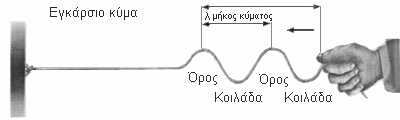
Some
important information about stationary waves:
When a traveling wave encounters another wave having equal width but opposite direction of
propagation, then the two waves contribute to each other. The contribution of the incident and reflected waves does not always cause stationary
waves. To create and maintain the stationary wave some synchronization of the oscillations must be made in relation to the source that causes them.
The two contracting waves in opposite direction must have equal frequency and equal width. The reflection of the wave at a constant point causes a
change in the wave phase. The stationary wave has some points that have a zero (or minimum) oscillating amplitude and other points that have a
maximum oscillation amplitude. The location of these points does not change over time and therefore the resulting waves are called stationary. For
example, when a string is pulled, the produced waves travel in both directions of the edges of the chord where they are interrupted and reflected to
the original oscillation point and meet there. The maximum oscillation amplitude is twice that of the initial waves that contribute. Points that do
not oscillate (such as the ends of a string) are called nodes or bonds unlike the so-called antinodes. The wavelength of the stationary wave is half
the initial wave, ie λ = λ / 2
Some
differences of stationary waves from traveling waves:
a) In
stationary waves, the amplitude of two waves is not the same along the length. The amplitude varies from zero to 2 times the amplitude of two
separated waves that contribute and depends on their location. In the traveling waves, all molecules or segments oscillate with the same width.
b) In
stationary waves there is no energy transfer while the traveling waves transport energy.
c) In the
stationary waves, there are points that remain motionless while in the traveling waves all the points oscillate.
d) In
stationary waves the points of the "elastic" medium pass simultaneously from their equilibrium position while in the traveling waves at different
times.
e) In
stationary waves, two points spaced less than λ / 2 have the same phase between two nodes. They have a phase difference equal to pi into side of the
node, while in the traveling waves two points in distance less than λ have a phase difference ranging from 0 to 2pi.
>>> The whole physical interpretation of the structure of the Universe and matter, with all paths of thinking that prepare and facilitate its
understanding and answer the questions which are created, extends to a large number of pages. The cosmological theory in Greek has divided into
three volumes or 3 digital archives respectively. The cosmological theory has been translated almost entirely and updated in English, and this
improved version is
available in digital form in only two files. >>>


 COSMOLOGY - COMPLETE UNIVERSE, MATTER, SPACE & TIME


